
Eyelid Lift Surgery (Blepharoplasty)
Conveniently located to serve Seattle and Bellevue
Jump To
Brighten Your Eyes with a Personalized Eyelid Lift in Bellevue, WA
Heavy, sagging, or puffy eyelids can make you look tired or older than you feel. At RP Plastic Surgery, we offer customized eyelid lift procedures in Bellevue to help restore a refreshed, alert appearance. Whether you’re dealing with excess skin that impairs your vision or looking to smooth under-eye puffiness, eyelid surgery can make a noticeable difference.
What Is Blepharoplasty?
Blepharoplasty, commonly known as eyelid surgery, is a cosmetic procedure that addresses the upper or lower eyelids. It can involve removing or repositioning skin, muscle, and fat to create a smoother, more youthful eye area.
- Upper Eyelid Surgery: Often performed to correct drooping or hooded lids.
- Lower Eyelid Lift: Focuses on reducing puffiness and under-eye bags.
- Double Eyelid Surgery: For patients wanting to define or enhance the upper eyelid crease.
Patients often combine eyelid surgery with a brow lift or facelift procedure for more comprehensive rejuvenation.
Reviews
Dr. Rikesh is absolutely amazing! He has an amazing personality and is very kind! I felt very comfortable with him and sharing my issues with him. If I needed to talk to him, he would bend over backwards to talk to me and answer all the questions and concerns I had. I was privileged to have had Dr. Rikesh as my surgeon. He listened to everything I wanted and took very good care of me. The results are amazing! My experience with him was wonderful and I recommend him to all my friends and family!
J.L.
Ideal Candidates
If you want to tighten sagging lids or alleviate puffiness, you may be a good candidate for an eyelid lift. Any individual in relatively good health can have eyelid surgery. The procedure can be performed under general anesthesia, sedation or local anesthesia. Upper eyelid sagging, excessive skin or fat as well as lower eyelid bags, excessive skin or fat can be treated by blepharoplasty surgery. This is a same day procedure and well tolerated. Contact us now for your consultation.
Am I a Candidate for Blepharoplasty in Bellevue, WA?
You might be a candidate for blepharoplasty if:
- You have excess eyelid skin, causing visual obstruction
- You’re bothered by puffiness or bags under your eyes
- You want to improve asymmetry in your eye area
- You’re in good health and don’t smoke
- You have realistic goals and expectations
During your consultation, Dr. Rikesh Parikh will assess your concerns and recommend the approach that suits you best.
What to Expect During Your Procedure
Eyelid lift procedures are typically done under local anesthesia with sedation or general anesthesia. Surgery may take one to two hours, depending on whether you’re having upper, lower, or both eyelids treated.
- Upper eyelid incisions are made in the natural crease to hide scarring.
- Lower eyelid incisions can be made just below the lash line or inside the eyelid for a scar-free result.
- Excess skin and fat are removed or repositioned for a smoother appearance.
Dr. Parikh uses advanced techniques to protect delicate structures and minimize trauma. Patients return home the same day.
Recovery and Results
For the first week, you can expect mild swelling, bruising, and sensitivity around the eyes. Cold compresses and head elevation help ease discomfort. Most patients return to light activity within a few days and regular routines within 10 to 14 days.
Final results become more visible over several weeks as swelling subsides. Scars fade with time and are usually well-concealed. Results can last many years, especially with good skincare and sun protection. Some patients also choose laser skin resurfacing post-recovery to enhance skin tone and texture.
Benefits of Eyelid Lift Surgery
An eyelid lift offers both cosmetic and functional improvements, such as:
- Brighter, more open-looking eyes
- Smoother under-eye area
- Improved field of vision (for those with drooping lids)
- Less tired or angry appearance
- Natural, subtle rejuvenation
Patients often report feeling more confident in social and professional settings after the procedure.
Cost of Eyelid Lift in Bellevue
Eyelid surgery costs at RP Plastic Surgery vary depending on the procedure’s scope. Pricing typically includes surgical fees, anesthesia, and follow-up visits. We’ll provide a personalized quote and review available payment plans during your consultation. Financing options are also available to ensure treatments are accessible to you.
Why Choose RP Plastic Surgery for Blepharoplasty in Bellevue, WA?
Dr. Rikesh Parikh is a double-board-certified facial plastic and reconstructive surgeon known for his precision and thoughtful approach to eyelid surgery. He focuses on subtle refinement, helping patients look refreshed without changing their natural expression.
His methods are designed to reduce scarring and support long-lasting results, all while keeping patient safety at the forefront. We take pride in offering every patient a smooth and professional experience in a well-equipped, welcoming space.
Our team is committed to providing knowledgeable care in a setting that prioritizes comfort and safety.
FAQs About Eyelid Lift
-
Can I lift my upper eyelids without surgery?
Only a little, and only for certain problems. If the lid itself sits low (ptosis) and an exam confirms that’s the cause, a prescription eye drop called Upneeq can raise it by about a millimeter for several hours at a time. It’s used once a day and wears off. If the heaviness comes from a low brow, Botox placed in the muscles that pull the brow down (not in the forehead, which can lower the brow further) can give a small lift. Lasers and peels improve skin texture and color but don’t remove skin. Extra skin folding over the lashes is a surgical problem, and no drop or injection takes it away.
-
Will insurance or Medicare cover an eyelid lift?
Sometimes, for the upper lids, when the extra skin blocks part of your vision. Plans call this “functional” surgery, and the proof they want is similar. That means photos showing the skin resting on or near the lashes, notes on how it affects daily life, like reading or driving, and for many plans a visual field test done with and without the skin taped up. The exact requirements and thresholds differ from plan to plan; Medicare, for example, leans on the photos and exam notes more than on formal field testing. Lower eyelid surgery is almost never covered, because bags under the eyes don’t block vision. If you’d like to try for coverage, say so at your consultation so the exam and photos are done the way your plan wants them. For anything your plan doesn’t pay, financing is available for patients who qualify.
-
Will it change the shape of my eyes or make me look surprised?
It shouldn’t. The goal is to take away only what’s extra and leave your eye shape alone. An upper lid needs a reserve of skin to close fully and protect the eye, so the trim is conservative by design. A startled look usually comes from a brow pulled too high or too much skin removed. Planning around how your face looks at rest keeps the risk of both low.
-
What are my options for bags under my eyes?
It depends on what’s causing the bag. If it’s fat pushing forward, the fat can be trimmed or moved down to fill the hollow beneath it. That’s done through an incision hidden inside the lower lid (transconjunctival), so there’s no scar on the skin. If the problem is crepey skin with little fat, a thin strip of skin can be removed just below the lashes (a skin pinch). Soft, puffy pouches lower down, between the lower lid and the cheek, are festoons. They’re a different problem and need a different plan. Filler is not a fix for festoons and can make them worse. You can see examples in the before-and-after gallery.
-
What’s the right age for eyelid surgery?
There isn’t one. Many patients are in their 50s and 60s, when the skin over the eyes starts to hood. People in their 30s and 40s with inherited bags under the eyes are good candidates too, and patients in their 70s and beyond do well as long as they’re healthy. What matters is the eyelid in front of Dr. Parikh, your eye health, and whether the change you want is realistic.
-
When can I wear contacts and glasses, read, and use screens?
Glasses are fine right away, as long as they don’t press on the incisions. Contact lenses can go back in at about 2 to 3 weeks, once the lids have healed enough to tolerate them. Reading and screens are fine after the first couple of days. Your eyes will tire faster than usual for a week or two, so take breaks and use lubricating drops. Mild blurring for a couple of days is normal and comes from swelling and ointment. A sudden loss of vision, double vision, severe pain, or swelling that gets worse fast is different: call the office right away.
-
Will I have visible scars?
Upper eyelid scars sit in the natural crease, so they’re hidden when your eyes are open and hard to find when they’re closed. Lower eyelid surgery done through the inside of the lid leaves no scar on the skin at all; when skin is removed, the line sits just under the lashes. Stitches come out in about 6 to 7 days. The lines are pink for a few weeks, then fade over several months to a year. Sunscreen on the area once the incisions are closed keeps them from darkening.
-
I have dry eyes. Can I still have eyelid surgery?
Often yes, with more care. Tell Dr. Parikh about your dry eyes and any drops you use. Your tear production may be checked before surgery, and a more conservative amount of skin is removed so the lids still close easily. Expect the dryness to be worse for a few weeks afterward, which is managed with lubricating drops and ointment. The thing to avoid is a lid that can’t close fully. That risk is higher when the eyes are already dry, so the planning is different for you.
-
How should I sleep after surgery?
With your head up. Two or three pillows or a recliner for the first several days keeps swelling down; some patients find it easier to stay propped up for the first couple of weeks. Sleep on your back and avoid rolling onto your face. Cold compresses in the first couple of days help with swelling and the feeling of tightness.
-
When can I drive and fly?
You can drive once you’re off any prescription pain medication and your vision is clear, which for most patients is within the first week. Flying is usually fine at 7 to 10 days, once the stitches are out and the early swelling has settled. Cabin air is dry, so bring lubricating drops and use them often. If you’re flying home from Seattle after surgery, ask Dr. Parikh before you book the return.
-
Can an eyelid lift be done with a facelift or neck lift?
Yes, and it’s common. Eyelid surgery addresses the eyes; a facelift or neck lift addresses the lower face and jawline, so doing them together keeps the whole face aging in step. It means one anesthetic and one recovery instead of two. The surgery takes longer, and your recovery follows the longer procedure’s timeline.
-
Is my problem extra skin or a droopy lid?
They look similar from the outside and are treated differently. Extra skin hangs over the lashes and is removed with an eyelid lift. A droopy lid (ptosis) means the lid margin itself sits low over the pupil usually because the muscle that lifts it has stretched or slipped; that needs a ptosis repair, which tightens the lifting muscle. Some patients have both. Both get checked at your exam, because fixing only the skin on a lid that droops leaves the heaviness behind.
-
Can eyelid surgery be redone if I’m not happy?
Yes, but for a cosmetic concern, wait for the final result first. (A lid that won’t close, or anything affecting your vision, is seen right away, not after a wait.) Swelling hides the real shape for months, and small differences between the two sides often even out on their own. Upper lids can’t have skin removed again and again, because each lid needs enough skin to close, so a revision there is about balance rather than taking more. Lower lid revisions address leftover fat, hollows, or a lid that’s pulled down. If something still bothers you once everything has settled, bring it to Dr. Parikh; the follow-up visits are for exactly that.
-
I live in Seattle. How many visits will an eyelid lift take?
Usually three or four. A consultation can start by phone or with photos, followed by an in-person visit with Dr. Parikh. Pre-op is mostly handled remotely. Then it’s surgery day, a visit at about a week to remove stitches, and a check-in a few weeks later that can often be done by photos. The office is about 20 minutes from downtown Seattle outside rush hour. You’ll need a ride home on surgery day. If you’re coming from farther away, the travel and stay page covers hotels and timing.
-
What are Dr. Parikh’s qualifications?
Dr. Parikh is double board-certified by both the American Board of Plastic Surgery and the American Board of Surgery. He completed his plastic surgery residency at Vanderbilt University and a research fellowship at Cleveland Clinic, and he is a Fellow of the American College of Surgeons. He performs upper and lower eyelid surgery, ptosis repair, brow lifts, and facelifts, so the whole upper face can be planned with one surgeon. You can see his patients’ results in the before-and-after gallery.
-
Does Dr. Parikh have hospital privileges?
Yes, at Overlake and Swedish. Dr. Parikh holds surgical privileges at Overlake Medical Center in Bellevue and at Swedish Medical Center, at both the First Hill campus in Seattle and the Issaquah campus. Privileges mean a hospital has reviewed a surgeon’s training, board certification, and record and allows him to operate there. Your eyelid surgery is done at RP Surgery Center, the practice’s state-accredited surgery center; the privileges are an outside check on his credentials.
This FAQ is general information and doesn’t replace the personal instructions Dr. Parikh will give you.
Upper blepharoplasty (upper eyelid surgery)
What is upper blepharoplasty?
Upper blepharoplasty, also known as upper eyelid surgery, was reported as the most popular facial cosmetic surgery in 2024, according to the American Society of Plastic Surgeons. This procedure is designed to restore a more refreshed and youthful appearance to the eyes.
One of the main reasons people have upper blepharoplasty is to improve sagging of the upper eyelids. This drooping skin can make it difficult to apply makeup, such as eyeliner or eyeshadow, and in some cases, may even interfere with peripheral vision. By removing excess skin or muscle, upper eyelid surgery improves both appearance and function, creating a brighter, more open eye shape.
In some cases, upper blepharoplasty may be contain additional procedures to enhance results. These may include:
- Fat repositioning or transfer to smooth hollows or restore volume
- Lacrimal gland surgery to address gland prominence
- Brow lift to improve the position of the brows and upper eyelid contour
Benefits of Upper Blepharoplasty
- Brighter, more youthful appearance around the eye
- Improved vision if it’s due to excess upper eyelid skin
- Improved eyelid contour and symmetry
- Easier make up application and removal from less excess skin and improved contour
- Long-lasting results (could be more than 10-20 years before another surgery is needed)
- Fast and easy recovery (compared to many other facial surgeries, upper blepharoplasty is one of the best tolerated procedures)
Who is a candidate?
You may benefit from upper blepharoplasty if you:
- Have droopy or heavy upper eyelids (if it is due to eye lid ptosis, then a ptosis repair will need to be done to correct it)
- Notice excess skin that makes your eyes look tired or aged
- Experience difficulty seeing due to skin folding over your lashes
- Are in good general health and have realistic expectations
- If you have serious eye conditions such as severe dry eyes, glaucoma, retinal disease, please discuss with your doctor before surgery.
Procedure
Upper eyelid surgery is generally very well tolerated. Most patients have the procedure under local anesthesia while awake, which allows for a safe and smooth experience. For added comfort, some patients may also choose sedation or general anesthesia.
The incision is carefully placed in the natural crease of the eyelid, making it well hidden once healed. The complexity of the procedure depends on what is needed to restore a youthful eyelid contour. Through the same incision, the surgeon may:
- Remove excess skin
- Adjust or reposition fatty tissue
- Perform lacrimal gland surgery (if needed)
- Address muscle concerns, such as levator advancement for ptosis repair
The length of surgery varies depending on the details of the case. A straightforward procedure may take as little as 30 minutes, while more complex surgeries may last over two hours.
Recovery
- Downtime: Most patients return to normal daily activities within 7 – 10 days. Return to strenuous exercise after 3 – 4 weeks.
- Swelling & Bruising: Common in the first week but gradually improves; can take up to 4 weeks.
- Sutures: Usually removed within 6–7 days.
- Final Results: Visible after swelling subsides, typically within a few weeks, with scars fading over several months to a year.
- Other considerations:
- Vision could be blurry for a couple days after surgery
- Eyes may feel dry and gritty and watery a couple days after surgery
- Avoid contact lenses and eye makeup until cleared by your surgeon (often 2–3 weeks)
Risks of upper blepharoplasty
Upper blepharoplasty is generally safe and well tolerated, but as with any surgery, there are potential risks:
- Dry eyes
- Common in the early healing period.
- Usually temporary, but if you already have dry eye syndrome, discuss this with your surgeon beforehand.
- Infection or bleeding (rare)
- Asymmetry or scarring (rare)
- If it occurs, conservative treatments or revision surgery may help improve the result.
- Vision problems (very rare)
- Injury to the eye muscles or globe is extremely uncommon but can cause temporary or permanent issues.
- In some cases, surgery may exacerbate pre-existing conditions such as glaucoma or retinal disease.
Your surgeon will discuss these risks and how they are minimized.
Upper Blepharoplasty and Browlift
“I went to a plastic surgeon and they told me I needed a browlift with an upper blepharoplasty.”
This is one of the most common questions / comments brought up by my patient in eyelid consultations. So, do you really need a brow lift along with upper blepharoplasty?
The answer depends on the individual. Generally, the older the patient, the more likely both procedures together will provide the best result in periorbital rejuvenation.
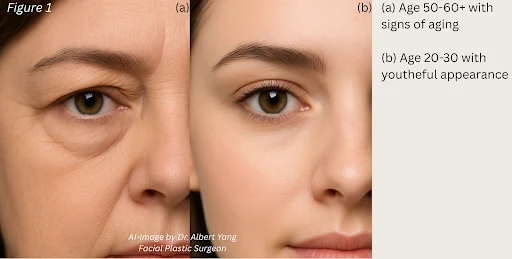
Figure 1 shows the aging changes around the eyes. At first glance the person in (a) is older than (b), but why? And what can we do about it?
When can a browlift be helpful in addition to an upper eyelid surgery?
A browlift may be considered along with blepharoplasty if the eyebrow position no longer reflects a youthful contour.
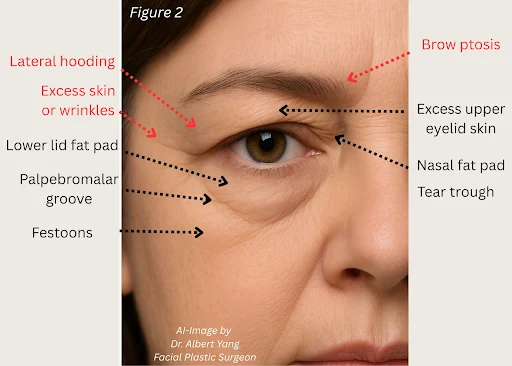
Signs can include: (figure 2)
- Brow position below the orbital rim (the bony ridge above the eye).
- Lateral hooding – outer eyelid excess skin caused by sagging of the lateral brow (the first area to droop with age).
- Forehead or glabellar (“11’s”) wrinkles, often a sign of overactive muscles compensating for brow descent.
- Eyes that appear tired, sad, or angry, even when well-rested.
Figure 2 illustrates the natural changes in the upper eyelid and brow that occur with aging. Eye brow aging contributes to brow ptosis, lateral hooding, and excess skin on the outer portion of the eye. Upper eyelid aging contributes to excess upper eyelid skin (ie. dermatochalasis), and fat pad protrusion.
In general
- Upper blepharoplasty addresses the excess skin that develops directly above the eye.
- Browlift focuses on the outer portion of the eye, where sagging of the lateral brow creates lateral hooding or excess skin around the crow’s feet area.
The Role of Forehead Wrinkles
Another important clue that a brow lift may be needed is the presence of forehead wrinkles. Sometimes the brows appear to be in a “normal” position, but in reality they are being held up by chronic overuse of the frontalis muscle (the muscle of the forehead).
- Over time, this constant lifting effort produces deep horizontal forehead lines.
- When Botox is injected to relax these lines, the frontalis can no longer elevate the brow. As a result, the underlying brow droop (brow ptosis) becomes unmasked, and patients suddenly feel their eyelids are heavier or “droopy.”
Other considerations
Lateral brow hooding: In some cases, patients may prefer to keep their brow in the same position or may not want to undergo a brow lift. For these patients, lateral hooding can sometimes be improved through:
- A subbrow (infrabrow) incision, or
- An extended upper blepharoplasty incision.
The main drawback of these approaches is that the incision line is not hidden within the natural eyelid crease. However, in most cases the scars heal well and become much less noticeable over time.
Facelift with eye surgery: If you are planning a facelift, a brow lift is often recommended at the same time. This ensures facial harmony, rejuvenating not only the midface and lower face but also the eyes and forehead, avoiding any mismatch between surgical areas.
Schedule Your Eyelid Surgery Consultation Today
Looking more awake and refreshed can be simpler than you think. An eyelid lift in Bellevue with RP Plastic Surgery could be the small change that makes a big difference. Whether you’re concerned about drooping lids or under-eye puffiness, we’re here to help you feel more confident in your appearance.