
Endoscopic Brow Lift Surgery
Conveniently located to serve Seattle and Bellevue
Jump To
Brow Aesthetics Female vs Male
Female eyebrows are 2-3 mm above the supraorbital rim (upper bony prominence of the eyeball socket) and have an arch shape. The apex of the arch is at the junction of the inner 2/3rd and outer 2/3rds of the eyebrow. This is the highest point of the eyebrow. The inner or medial part of the eyebrow located at the inner corner of the eye is the low point. The eyebrow, then gently arches up towards the apex where the outer part of the eyebrow is 2-3 mm higher than the inner part.
Reviews
Dr. Parikh is the most patient and down to earth plastic surgeon. He has done my botox and augmented my breasts. I am always so happy with my results. Even with traveling out of state, Dr. P and his staff make everything so easy. I recommend him to all my friends and family.
B.C
 Male Eyebrows on the other hand, are located right on the supraorbital rim. They are less arched and straight. The outer part of the eyebrow is close to the same level as the inner part of the eyebrow. The arching that you see is mild to none.
Anatomy of the Brow
The brow is the front area of the scalp with the following layers;
- Skin
- Subcutaneous Tissue or Fat
- Galea or Frontalis muscle
- Loose areolar tissue layer
- Pericranium or Periosteum
From the superior orbital rim to the hairline the brow length is 5 – 6 cm. Anything more than this can be considered a high forehead anything less and short forehead.
The important nerves and vessels that pass through the brow are the supraorbital and supratrochlear nerves, the frontal or temporal branch of the facial nerve, the sentinel vein, and the supratemporal artery and vein.
 Eyebrow Muscles
The Frontalis muscle is responsible for brow elevation and creates “worry lines”, the horizontal creases, one sees when they elevate the brow. Botox is commonly used to temporarily treat these lines. Depressors of the brow include the Procerus muscle, corrugator muscles, and the orbicularis oculi muscle. These muscles create the 11’s lines when contracted.
The depressor muscles are important in brow lift because they act as the “brakes” or opposing force for trying to raise the brow up. These muscles can be removed during surgery either partially or almost completely to resist these opposing forces.


Ligaments or Fusion Points
These are strong adherence areas of the brow to the underlying facial skeleton. They fix the brow in position and must be released during surgery to allow mobilization of the brow so that it can be moved upwards.
- Arcus Marginalis at the Superior Orbital Rim
- Superior Temporal Fusion Line
- Lateral Orbital Retaining Ligament
Brow Droop or Ptosis
The brow drops with the weakening of the ligaments and soft tissues. Some patients have low eyebrows genetically. Drooping of the brow will affect the overall appearance of the upper face and eyes. The severity of bow descent and baseline anatomy will determine what procedure will be most effective.
Types of Procedure Performed
- Open Brow Lift: The incision is in three main areas;
- Coronal: 5-6 cm behind the hairline from one side to the other
- Pretrichial or Hairline: Along the hairline
- Direct Brow: Upper part of the eyebrow
- Endoscopic Brow Lift (Minimally Invasive): Small incisions behind the hairline which are well hidden in the hair-bearing area.
- Minibrow Lift: Various incisions in front of the hairline or behind the hairline that are smaller. This may be limited to the temporal brow for a lateral or outer eyebrow lift.
 Endoscopic Technique
This is minimally invasive with small incisions behind the hairline. In general, no skin is removed and the lift is created by the suspension of the underlying tissues. It is important to go to a Plastic Surgeon who is familiar with this technique. The downtime is less than the open technique and healing is quicker.
How Much Does Brow Lift Cost?
The cost of a Brow Lift varies depending on the work your operation requires. Prescribed post-operative medications, anesthesia, and hospital fees can also affect the overall cost.
A Brow Lift procedure is purely aesthetic in nature, and because of this, medical insurance will not cover it. We offer financing options like Alphaeon Credit, CareCredit, and PatientFi to make procedures like mini facelifts convenient and accessible for patients.
Age Related Changes of the Eyebrow
Aging affects the eyebrows in gradual and predictable ways, though the rate and pattern of change can vary significantly across different ethnic groups. Over time, several key transformations occur:
1. Gradual Descent of the Eyebrow
- The lateral (outer) brow tends to droop more noticeably than the inner portion. This contributes to lateral hooding.
- Studies show it may drop by 2–3 mm every 20 years, leading to heaviness over the outer eyelids.
2. Flattening of the Brow Arch
- The apex (highest point) of the brow becomes less pronounced with age.
- This reduces the youthful arch and contributes to a flatter brow shape.
3. Shift of the Brow Apex
- The brow peak gradually shifts further laterally (outward) over time.
- This contributes to female eye brow looking more masculine with age
4. Brow Thinning
- With age, hair density decreases, leading to a thinner brow appearance.
- This can be more apparent with menopause. The decline of estrogen can reduce hair density and caliber
What is a youthful brow contour?
The eyebrows play a key role in facial expression, character, and balance. Their shape and position can vary based on gender, ethnicity, age, and even fashion trends. Understanding these differences is important in both makeup design and cosmetic surgery.
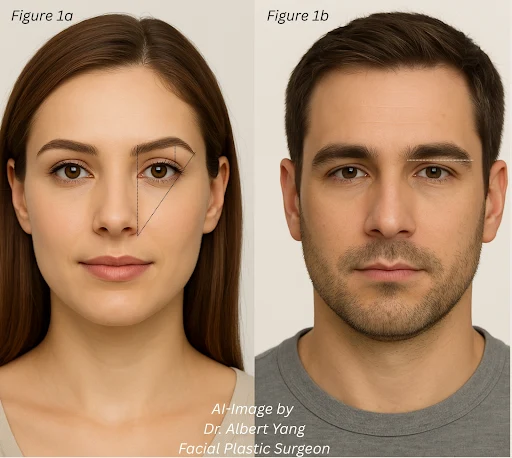 Female Eyebrows (Figure 1a)
Shape
- Typically show a gentle arch.
- The apex (highest point) of the arch usually peaks at or just lateral to the lateral limbus (the outer edge of the iris).
- The medial brow “head” aligns with the nasal ala (side of the nostril) when traced vertically upward.
- The tail of the brow aligns on a diagonal line from the base of the nostril through the lateral canthus (outer corner of the eye).
Position
- Generally sit a few millimeters above the supraorbital rim (the bony ridge above the eye socket).
- The lateral tail is often the same height as, or slightly higher than, the medial brow head.
Male Eyebrows (Figure 1b)
Shape
- Usually straighter and flatter than female brows.
- Tend to be thicker, heavier, and less arched.
- The arch, when present, is usually located more lateral than in female brows.
Position
- Typically sit at or just above the supraorbital rim, about 2.5 mm lower than female eyebrows on average.
- This lower placement gives the brow a heavier, stronger, and more masculine appearance.
Ethnic differences in women’s eyebrows:
The shape, position and density of eyebrows can vary significantly across ethnic groups. These differences influence brow shape, position, and cosmetic preferences.
East Asian Women (Chinese, Japanese, Korean)
- Shape: Brows are typically straighter and less arched compared to Western norms.
Position: Sit closer to the orbital rim - Hair density: Usually moderately dense, with smooth, dark brow hairs
African Descent (Wide variation)
- Shape: Eyebrows tend to be flatter and less arched.
- Position: Sit closer to the orbital rim
- Hair density: Brows may appear shorter in length, with less overall hair density
FAQS about Brow Lift
-
Do I need a brow lift or an eyelid lift?
Try this in a mirror. Rest a finger just above one eyebrow and gently lift the brow to where you’d like it. If the heaviness over your eye disappears, the brow is the problem and a brow lift is the answer. If there’s still loose skin folding over the lid, you need an eyelid lift (upper blepharoplasty), or both. An eyelid lift removes the skin directly above the eye; a brow lift treats the outer part of the eye and the forehead. Many people who come in asking for eyelid surgery actually have a low brow, and eyelid surgery alone on a low brow can pull the brow even lower. Dr. Parikh does both, so the plan can follow what the mirror shows, even if that’s not the procedure you came in asking about.
-
How is the brow held up, and will I feel anything under my scalp?
In an endoscopic lift, the lifted tissue is anchored to the bone with dissolvable anchors or with stitches. You can’t see them, but you may feel small bumps under the scalp for several months while a dissolvable anchor is absorbed, and the spots can be tender early on. Once the anchor has dissolved, the bumps go with it.
-
Will I look surprised?
Not when the right part of the brow is lifted by the right amount. The startled look comes from lifting the brow too high, especially in the middle. A natural lift concentrates on the outer brow and returns it to where it used to sit, not higher. The bias is toward subtle, because an over-lifted brow is hard to correct and a conservative one is easy to touch up.
-
Can Botox lift my brows instead?
It can lift them a little, and not for long. Botox relaxes the muscles that pull the brows down, which lets the outer brow rise a few millimeters, and the effect lasts about 3 to 4 months. It’s a good option for early heaviness, and many patients keep using it after surgery to soften forehead lines. But it can’t move tissue that has descended. If lifting your brow with a finger makes a real difference, Botox won’t get you there.
-
Will the scars show?
For an endoscopic or coronal lift, the scars sit in your hair. A hairline incision leaves a fine line along the hairline that fades well but can show if you pull your hair straight back. A direct brow lift scar sits just above the eyebrow and can be visible. Like any scar, they’re permanent, and they fade over the first year. Some hair along any scalp incision can thin for a few months after surgery and usually grows back.
-
How painful is it, and what is recovery like?
Expect tightness and mild discomfort for the first few days rather than sharp pain. Swelling peaks around day 2 or 3 and settles over the next 2 to 3 weeks. Bruising often drifts down around the eyes and takes a week or two to fade. You’ll sleep with your head elevated for the first week, and stitches or staples come out at about 7 to 10 days. You can gently wash your hair a day or two after surgery; hold off on hair color for about 4 weeks. Most people are back at a desk about a week after an endoscopic lift and 10 to 14 days after an open one. Walking is fine right away. Give it about a month before strenuous exercise.
-
Will my scalp be numb or itchy?
You’ll likely have both. Numbness and tingling across the top of the scalp are expected after a brow lift, and as the nerves recover over the following weeks the scalp often gets itchy. That’s a sign of healing, not a problem. Feeling usually returns over a few months; a small area of lasting numbness is possible but uncommon.
-
When will I see the result, and how long will it last?
You’ll see the lift as soon as the swelling comes down, within 2 to 3 weeks, and the final result settles in over about 6 months. It’s long lasting, though not forever: your face keeps aging, so the brows drift down slowly again over the years, but from a higher starting point than before.
-
Is a brow lift safe? What are the risks?
For a healthy patient it is, and it’s one of the gentler facial operations to recover from. The risks are the usual ones for any surgery: bleeding, infection, and swelling. Specific to a brow lift are numbness or itching of the scalp, hair thinning along the incisions, a scar that’s more visible than planned, brows that end up slightly uneven, and a lift that relaxes a bit as the tissue heals. Temporary weakness in raising one eyebrow can happen while a nerve recovers; lasting weakness is rare.
-
Can I combine a brow lift with eyelid surgery or a facelift?
Yes, and it’s common. A brow lift and upper eyelid surgery are often done together because they treat two halves of the same problem. If you’re planning a facelift, a brow lift at the same time keeps the upper and lower face aging in step. It also means one anesthetic and one recovery instead of two.
-
I live in Seattle. How many trips to Bellevue will a brow lift take?
Three or four. A consultation can start by phone, video, or photos, followed by an in-person visit with Dr. Parikh. The pre-op appointment is mostly handled remotely. Then it’s surgery day, a check in the first day or two, a visit at 7 to 10 days to remove stitches or staples, and a check-in a few weeks later that can often be done by photos. The office is at 301 116th Ave SE in Bellevue, just off I-405, about 20 minutes from downtown Seattle outside rush hour. You’ll need a ride home on surgery day, and driving waits until you’re off prescription pain medication. If you’re coming from farther away, the travel and stay page covers hotels and timing.
-
What are Dr. Parikh’s qualifications?
A brow lift is a small operation where millimeters decide the result, so experience matters. Dr. Parikh is double board-certified by both the American Board of Plastic Surgery and the American Board of Surgery. He completed his plastic surgery residency at Vanderbilt University and a research fellowship at Cleveland Clinic, and he is a Fellow of the American College of Surgeons. He performs endoscopic, open, and direct brow lifts along with eyelid surgery and facelifts, so you can compare every option with one surgeon. You can see his patients’ results in the before-and-after gallery.
-
Does Dr. Parikh have hospital privileges?
Yes, at Overlake and Swedish. Dr. Parikh holds surgical privileges at Overlake Medical Center in Bellevue and two locations for Swedish Medical Center one at the First Hill Campus location in Seattle and the other at the Issaquah Campus. Privileges mean a hospital has reviewed a surgeon’s training, board certification, and record and allows him to operate there. Your surgery is done at RP Surgery Center, the practice’s state-accredited surgery center; the privileges are an outside check on his credentials.
This FAQ is general information and doesn’t replace the personal instructions Dr. Parikh will give you.
Schedule a Consultation
Schedule your consultation for Brow Lift in Bellevue– contact Dr. Parikh and set up your appointment. During your appointment, you will be able to ask questions and bring up any concerns you may have about the procedure. Contact us today to get the look you’ve always wanted!
Candidates
Longer foreheads are generally not ideal candidates for a coronal incision. This technique will result in the hairline moving back and making the forehead appear longer. Short foreheads are ideal because this technique will elongate the forehead and provide a better balance to the facial aesthetics. Hairline incisions are good for longer foreheads that will not push back the hairline. The direct brow lift is less invasive, however, there is a scar above the eyebrow that can possibly be seen. It is important to set the goals and expectations in a thorough consultation with Dr. Parikh prior to your procedure. We can offer brow lifts either awake or asleep.
Related Blog Posts

HOW CAN I MAKE MY FACE LOOK MORE FEMININE?
Many trans women want to make their outer aesthetic better match their inner authentic self. This leads to undergoing facial-feminization surgery. Facial-feminization surgery is ideal for trans women who experience … Read More