Asian Blepharoplasty
Conveniently located to serve Seattle and Bellevue
Jump To
– Dr. Albert Yang
What Is Asian Blepharoplasty?
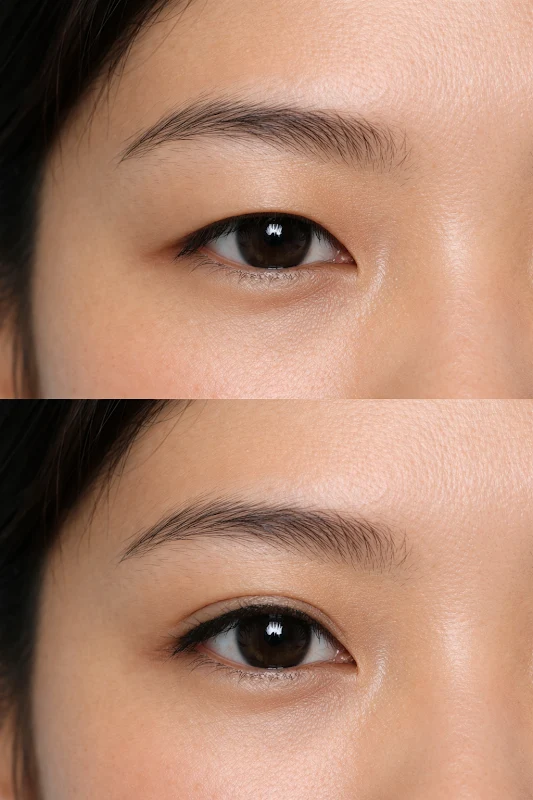
Approximately 50% of people of Asian descent have single upper eyelids. While this is a normal variation, it can make the eyes appear smaller and less defined. This may give the impression of appearing tired, shy, or reserved. The goal of this procedure is to create a crease in the upper eyelid so that the eyes appear more open and inviting. Patients with eyelid asymmetry, puffiness, excess fat, or eyelid drooping (ptosis) can also be treated at the same time.
Who Is the Ideal Candidate?
The ideal candidate has thin skin, larger eyes, minimal or no epicanthal fold, and no brow or eyelid ptosis.
Patients with puffy eyes or ptotic eyelids and brows may experience early relapse of the fold.
Anatomy
-
Supratarsal Crease
In Caucasian eyelid anatomy, fibrous connections exist between deeper structures and the eyelid skin, allowing a fold to form when the eyelids open. In Asian eyelids, these connections are weak or absent. Therefore, the procedure requires adhesion of deeper structures to the eyelid skin to create the supratarsal crease (double eyelid).These connections are approximately 3.7 mm higher in Caucasians than in Asians. The goal of surgery is not to westernize the eyelid. Therefore, Asian double eyelids are generally designed lower than those in Caucasian populations. Males tend to prefer a lower crease than females to avoid feminization of the eyelid.
-
Medial Epicanthal Fold
This refers to overhanging skin and muscle present in some Asian eyelids that can make the eyes appear narrow. It may interfere with the aesthetic formation of a double eyelid. -
Periorbital Fat (Pre-Aponeurotic Fat)
These fat layers lie deep to the eye muscle and can make the eyelids appear puffy. This may hinder crease formation. In some patients, fat removal is necessary to allow better adhesion and formation of the double eyelid. Excessive fat removal can result in a hollowed appearance, which may require fat grafting.
Surgical Approaches
There are three main methods to achieve a double eyelid.
-
Full Incision Technique: This method involves making a controlled incision along the upper eyelid.
Advantages:
- Long-lasting and reliable results
- Allows removal of excess skin, muscle, and fat
- Enables simultaneous correction of ptosis
Limitations:
- Requires a longer healing period
- Swelling may persist for several weeks
- Sutures are typically removed after one week
-
Partial Incision Technique: This approach uses a shorter incision while still allowing limited tissue adjustment. Best suited for patients with thin skin, minimal fat, and good eyelid support.
Advantages:
- Faster recovery than full incision
- Improved durability compared to suture-only methods
- Can address mild fat excess
-
Non-Incisional (Suture) Technique: This technique uses fine sutures placed through small punctures without a full incision. Most appropriate for patients with very thin skin and minimal eyelid fullness.
Advantages:
- Minimal scarring
- Short recovery period
- Less invasive
Limitations:
- Results are temporary in many patients
- Crease may loosen over time
Other Considerations
-
Eyelid Ptosis: Ptosis refers to drooping of the upper eyelid, which can impair vision and make a person appear tired. The prevalence is approximately 5–30%, most commonly in females. It may present asymmetrically, with right-sided ptosis more common than left. Diagnosis can be challenging because some patients raise their eyebrows to compensate. If ptosis is present and treatment is desired, an external double-eyelid approach is ideal to address both conditions simultaneously.
-
Medial Epicanthoplasty: The medial epicanthal fold near the nose can interfere with crease formation. This procedure is often performed with double eyelid surgery to make the eyes appear larger and more inviting. It also enhances the visibility of the double eyelid crease.
-
Brow Ptosis: Some patients have a low eyebrow position, which leads to excess upper eyelid skin and contributes to pseudoptosis. Low eyebrows can convey a tired, sad, or angry appearance. Brow repositioning can be performed with double eyelid surgery to improve eyebrow contour.
Things to Know About Double Eyelid Surgery
- Patients should be in good overall health
- Surgery is usually performed under local anesthesia; light sedation may be used if requested
- Avoid smoking and alcohol before and after surgery
Recovery After Double Eyelid Surgery
- Apply ice during the first 3–4 days (15 minutes per session, 6–8 times daily if possible)
- Sutures are removed in 6–8 days
- Most swelling improves within 10–14 days; final results appear in 3–6 months
- Avoid makeup, exercise, and contact lenses for 2 weeks
- Mild asymmetry and temporary ptosis may occur; allow 3–6 months before final evaluation
Risks of Double Eyelid Surgery
- Infection and bleeding
- Scarring
- Asymmetric crease positioning
- Eyelid ptosis (subclinical ptosis may become noticeable)
- Crease disappearance (may require revision surgery)
- Suture exposure
- Dry eyes
- Vision loss (extremely rare)